
How to Get Clients on Instagram Without a Large Following
You do not need more followers first. You need to make better use of the people already paying attention: content built around the problems your ideal clients have, a profile that explains what you sell, and a storefront where someone can understand the offer, pick a slot and pay without sending you a single message.
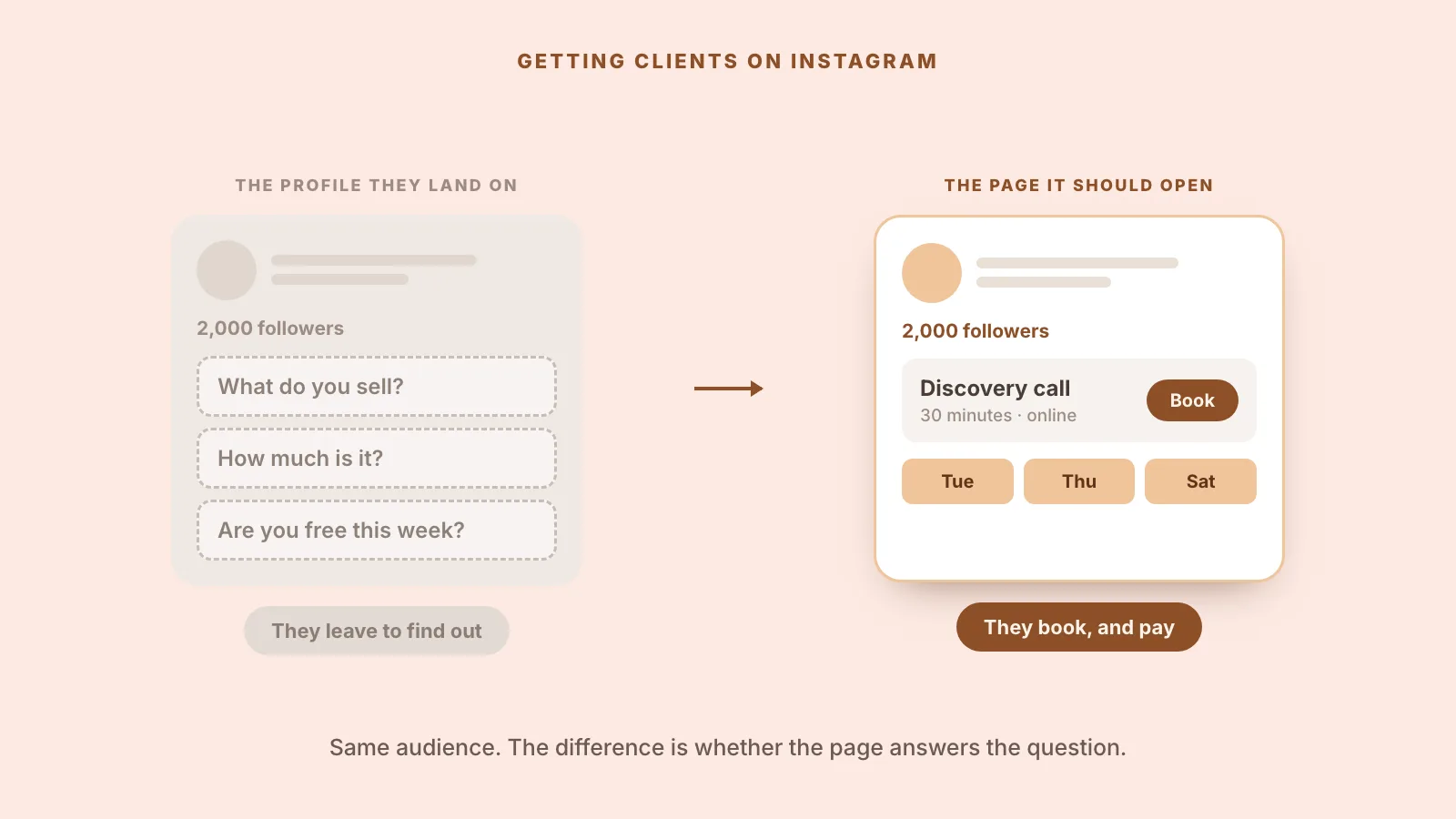
You have been posting consistently on Instagram, sharing useful content and trying to build an audience, but the client enquiries are still not coming in as often as you expected. Meanwhile, you see other creators with tens of thousands of followers announcing new clients, selling coaching packages and promoting their services almost every week. It is easy to assume that the missing piece is simply your follower count.
But that is not always the case.
A large following can certainly help, but it does not guarantee customers. A person with 2,000 relevant followers can generate more business than someone with 100,000 followers who has never clearly explained what they sell. For independent coaches, consultants, nutritionists, fitness professionals, freelancers and creators, the real challenge is often turning attention into a clear path towards becoming a client.
People may discover your Reel, visit your profile, read a few posts and even become interested in your service. Then they leave because they cannot quickly understand what you offer, how much it costs, whether you are available, or how they can actually work with you.
That is the part of the Instagram journey worth fixing.
You do not necessarily need more followers first. You need to make better use of the people who are already paying attention.
Start With the Right Audience, Not the Biggest Audience
It is tempting to measure Instagram growth almost entirely through followers and views. These numbers are easy to see, and watching them increase feels like progress. However, they do not tell you whether the people following you are potential customers.
Consider a nutritionist who has 3,000 followers, most of whom regularly engage with posts about weight management, meal planning and healthy eating. If even a small percentage of those followers need personalised support, the nutritionist already has a meaningful pool of potential clients.
Now compare that with a creator who has 50,000 followers gained from entertainment content that has little connection with their paid service. The second account looks more successful from the outside, but the first account may have a much stronger commercial opportunity.
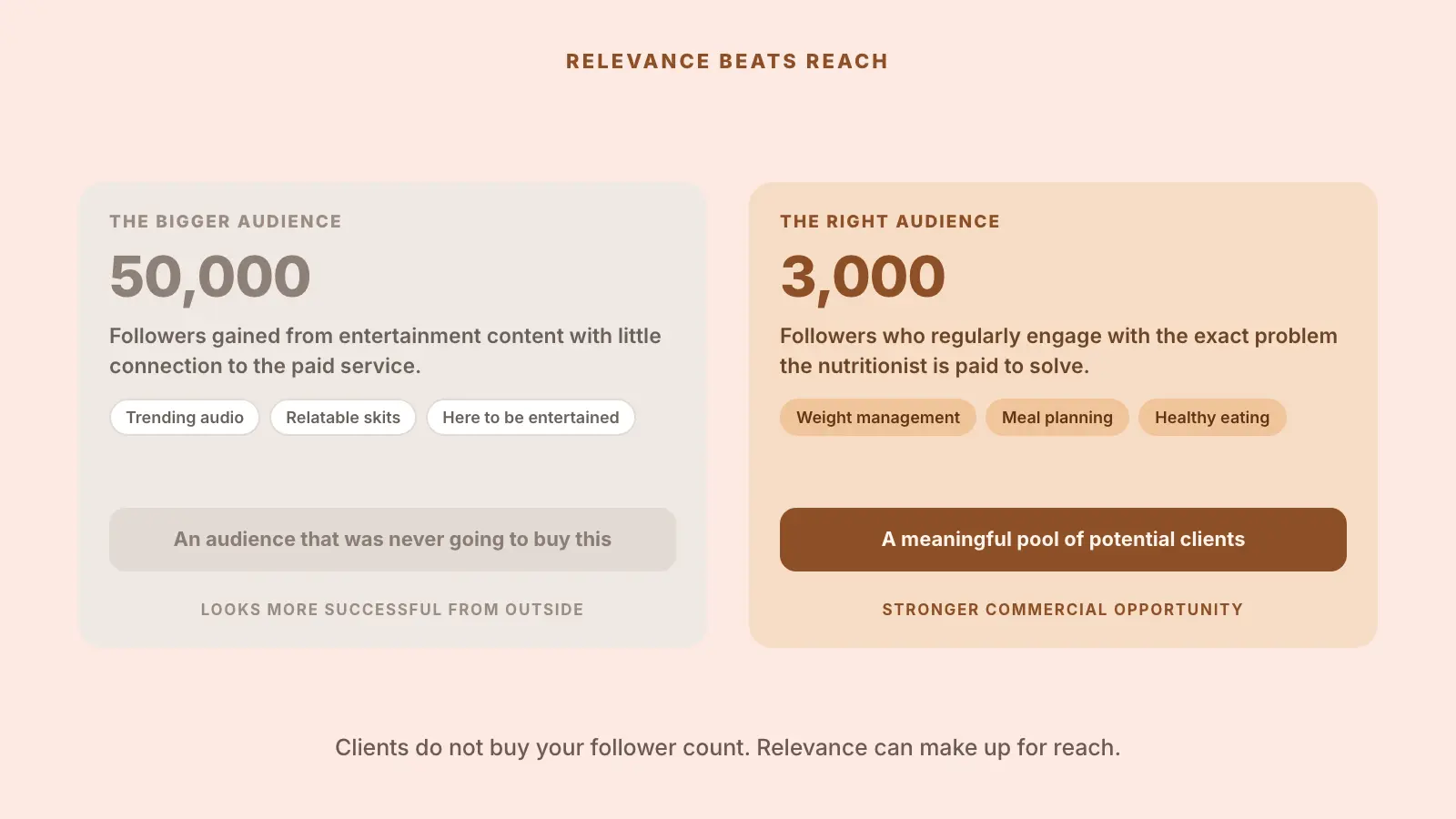
This is why your content should be designed around the problems your ideal clients are already experiencing.
A career coach could create content around common interview mistakes, changing careers after several years in one industry, or preparing for a difficult salary negotiation. A fitness coach could discuss why people stop seeing progress despite exercising regularly. A consultant could explain the problems that small businesses face when their sales process becomes difficult to manage.
These topics attract people because they address something they already care about. And when the person who needs your service discovers that you understand their problem, the conversation becomes much easier.
Create Content That Makes Potential Clients Recognise Their Problem
Not every Instagram post needs to sell something.
In fact, constantly asking people to book a consultation can make your content feel like a sales catalogue. Your first job is to make the right people stop scrolling because something you said is relevant to them.
Think about the questions people ask you repeatedly.
What do clients struggle with before they hire you?
What mistakes do they make?
What do they misunderstand about your area of expertise?
What would you explain to someone if they sat across from you for 20 minutes?
Those questions can become your content strategy.
For example, instead of posting another generic message about the importance of eating healthy, a nutritionist could explain why someone can follow a meal plan during the week but repeatedly lose consistency over the weekend. That is a much more specific problem, and someone experiencing it is far more likely to pay attention.
The same principle works across professional services.
Your content should not simply demonstrate that you know your subject. It should help potential clients understand that you know their situation.
That distinction is important when you have a smaller audience because relevance can compensate for reach.
Your Instagram Profile Needs to Explain the Business
Once your content gets someone's attention, the next step is usually a profile visit. This is where many independent professionals lose potential enquiries.
Your profile may look attractive, but can a new visitor understand what you actually offer? They should not have to scroll through dozens of posts or send you a DM simply to figure out whether you provide one-to-one consultations, coaching packages, workshops or digital products.
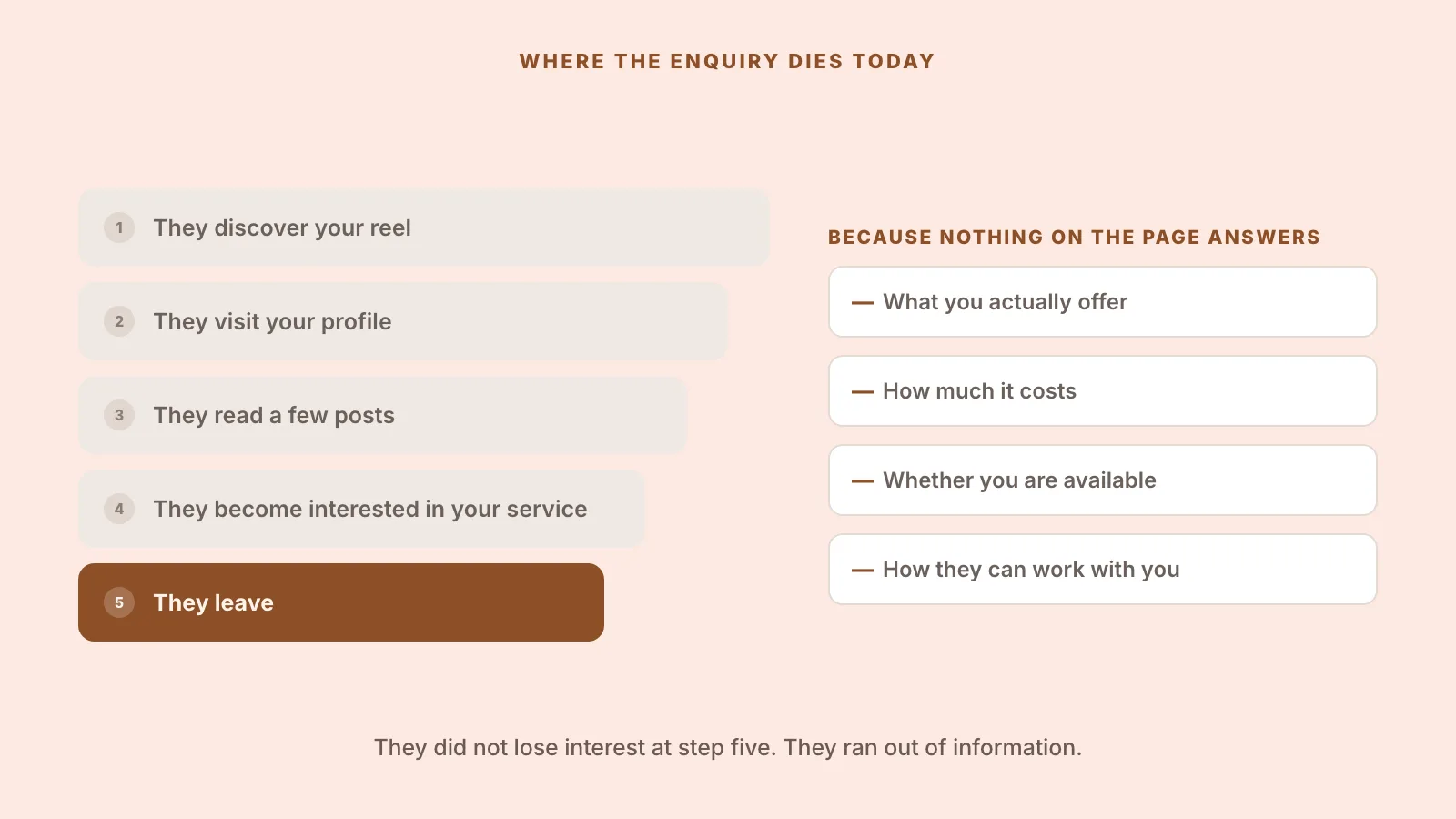
Your bio, featured content, and link should work together to answer a few basic questions: who you help, what you help them with, and what they can do next.
You do not need to make your profile sound corporate. It should still reflect your personality. But clarity matters more than clever wording when someone is considering spending money with you.
If you offer several services, your bio link becomes particularly important because it gives you a place to organise everything without filling your Instagram profile with multiple directions. The mechanics of putting one there are covered step by step in how to add a booking link to your Instagram bio.
Turn Your Bio Link Into a Place Where Business Can Happen
A traditional link-in-bio page usually does one simple job: it gives people a list of links. That is useful, but a service business often needs more.
Imagine that someone has just watched your content and wants to book a consultation. They click your bio link and find a page containing links to your website, YouTube channel, Instagram, WhatsApp, a calendar and perhaps a payment page.
Now they have to work out what to click.
They may need to visit another website to understand the service, another platform to find an available time and another page to make payment. Every additional step gives them another opportunity to leave. That argument is made at length in why every creator needs a link-in-bio store instead of just a bio link.
Setav takes a broader storefront approach. Instead of using your bio link simply as a collection of destinations, you can use it as a professional digital space for presenting your services and guiding visitors towards actions such as booking and payment. Setav also provides features for forms and tasks, shared spaces and analytics, which can support the client journey beyond the initial Instagram click.
This is particularly useful for independent professionals because you can bring several parts of the customer journey together rather than managing everything through separate tools.
Give Interested People a Clear Way to Become Clients
There is a big difference between someone being interested in your content and someone being ready to buy. Your job is to make the transition between those two stages as simple as possible.
Suppose someone finds your Instagram account because of a post about improving business operations. They are interested in your consulting service but do not want to exchange ten messages just to understand the package and availability.
A better journey would allow them to visit your storefront, understand the service, check the available appointment slots, provide the information you need and complete the booking.
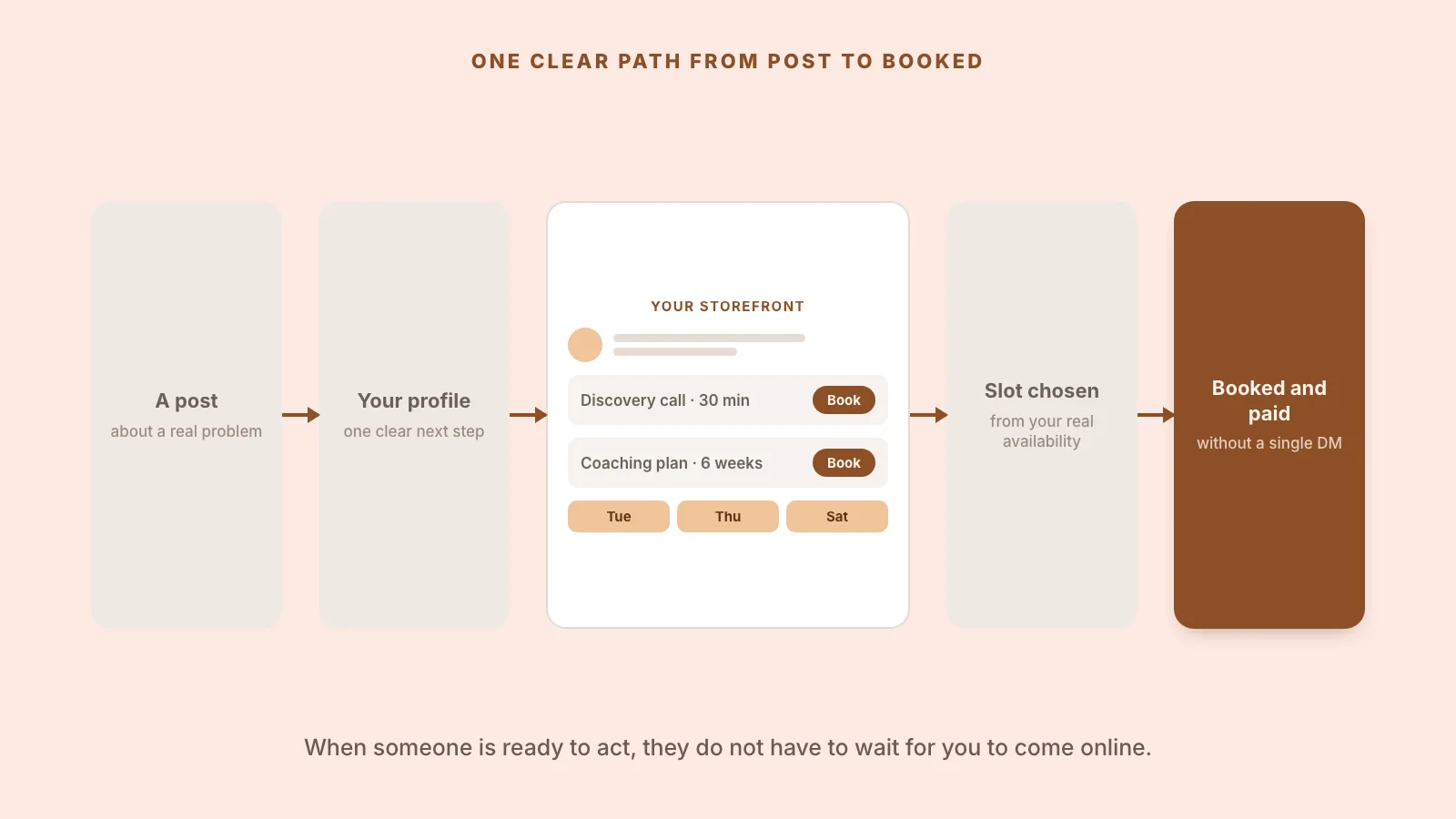
Setav's Booking Calendar is designed to let businesses offer appointment scheduling through their digital presence rather than depending entirely on manual conversations. Its payment functionality can also support the transaction as part of the customer journey, over UPI, cards and wallets. Setav takes no commission on your bookings.
The advantage is not simply convenience.
It means that when someone is ready to act, they do not have to wait for you to come online.
Do Not Make Every Client Conversation Start in the DMs
Instagram DMs are useful for building relationships, answering questions and having genuine conversations with your audience.
The problem starts when your entire business operation happens inside them.
If every enquiry requires you to explain your prices, check your calendar, collect client information, send payment instructions and confirm appointments manually, your Instagram account can quickly become an administrative workload. The most expensive version of that habit, the hidden cost of "DM me for pricing", has a post of its own.
This becomes especially difficult as your audience grows.
You may have only a few hundred active followers today, but if several people start enquiring every week, the repetitive questions begin to take up valuable time.
A storefront can handle the routine parts while you keep the personal communication for situations where it actually adds value. That is a much more sustainable model.
Use Forms to Understand the Client Before the First Conversation
Another advantage of moving beyond a simple bio link is the ability to collect useful information before a client starts working with you.
A fitness coach may need to know a client's current fitness level and goals.
A nutritionist may need dietary preferences and other relevant information.
A business consultant may need basic information about the company and the problem they want help solving.
Asking all of these questions manually through Instagram or WhatsApp is slow and difficult to organise. Setav's Tasks & Forms functionality can help structure this information as part of your workflow. If you are not sure what to ask, there is a set of client intake form questions to start from.
This means the first actual consultation can start with context rather than another 15-minute conversation about basic details.
For a solo professional, those small savings add up.
Make the Offer Easy to Understand
A common mistake among professionals with smaller audiences is trying to compensate for their limited reach by creating too many offers.
You might have a 30-minute consultation, a 60-minute consultation, a monthly package, a premium package, a workshop and several digital products. There is nothing wrong with having different options, but presenting all of them at once can make the decision harder.
Start with the offer that makes the most sense for someone who is discovering you for the first time. It could be a consultation, an audit, an introductory coaching session or a small digital product you can sell straight from Instagram.
Then explain it properly.
What it is.
Who it is for.
What the client receives.
What happens after they book.
If someone has to ask five questions before understanding what they are buying, the offer probably needs clearer presentation. Your storefront should reduce those questions rather than create more of them.
Build Trust Before Asking for the Sale
A person who discovers you today may not become a client today. That is normal.
Someone may need to see several pieces of your content before they feel comfortable paying for your service. This is why your Instagram should contain enough useful material for people to understand your expertise and approach over time.
Share your knowledge.
Explain your process.
Talk about common mistakes.
Answer questions.
Show how you work.
Use genuine client results as evidence, where they can be shared appropriately.
That last one matters more than the rest: use real experiences to provide evidence rather than simply claiming that you are good at what you do.
Trust is built through repeated exposure. And when that trust is combined with a straightforward booking experience, the chances of turning an interested follower into a paying client become much stronger.
Look at Actions, Not Just Followers
Once you have a storefront, you can start thinking about Instagram traffic differently. Instead of asking only whether your follower count increased this month, you can ask more useful questions.
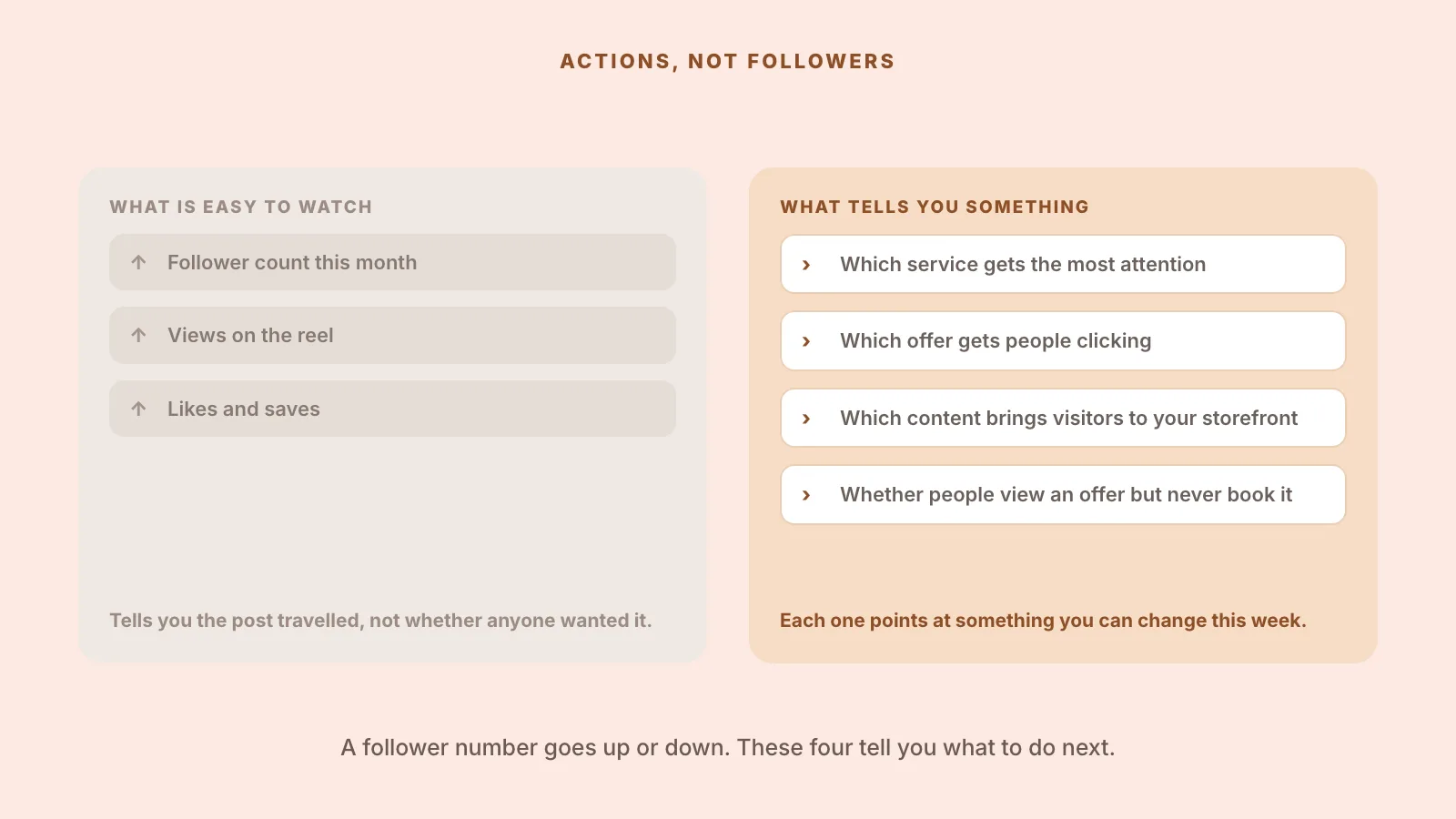
Setav's Real-Time Analytics can help you understand activity around your storefront and its offerings.
Suppose a particular type of Instagram content consistently sends visitors to your storefront, but they rarely purchase your premium service. That does not necessarily mean the content failed. It could mean the content is attracting interest, while the offer needs better positioning.
You can change the description, adjust the offer, highlight another service or introduce a lower-barrier option. This creates a useful feedback loop between your content and your business.
Over time, you are no longer posting simply because you think something might perform well. You are learning what attracts the right people and what encourages them to take action.
You Can Start With 1,000 Followers
There is a strange pressure on Instagram to reach a particular number before taking your business seriously. 10K followers. 50K. 100K.
But clients do not buy your follower count.
They buy because they have a problem, they trust you to help them solve it and they understand how to get started.
A smaller audience can therefore be enough to build a real service business if the audience is relevant and the customer journey is clear.
You might not get hundreds of enquiries every month. You do not necessarily need them. If your service is valuable and your positioning is clear, a small number of qualified enquiries can create meaningful revenue.
That is a much healthier goal than chasing followers simply because the number looks impressive.
Where Do You Go From Here?
If you are waiting to reach a large follower count before you start turning Instagram into a proper client acquisition channel, there is a good chance you are overlooking the audience you already have.
Go back through your recent content and identify the posts that generated genuine questions or conversations.
Look at the problems people repeatedly mention.
Choose one service that solves a specific problem and make it easy to understand.
Give people a clear path from your Instagram profile to that service.
That path does not have to be complicated.
With Setav, you can create a professional digital storefront that brings together your offerings and provides tools for bookings, payments, forms, client tasks, shared spaces and real-time insights. Instead of asking potential clients to navigate several disconnected platforms, you can give them a more organised place to take the next step.
You may still want to grow your Instagram audience, and you should. But do not make growth a prerequisite for building the business.
The short version
You do not need thousands of people watching you. You need the right people to understand what you can do for them, trust you enough to take action, and have an easy way to become your client.
Give the followers you already have one page that explains the offer, shows your open slots and takes the payment. Free to start, no credit card.
Turn conversations into customers with Setav's smart all-in-one professional storefront platform.
All Rights Reserved © Setav 2026